> For the complete documentation index, see [llms.txt](https://docs.pantherprotocol.io/docs/llms.txt). Markdown versions of documentation pages are available by appending `.md` to page URLs; this page is available as [Markdown](https://docs.pantherprotocol.io/docs/panther-core/panther-core/zaccount.md).
# zAccount
zAccounts
| Status | Entrypoint |
| ------------------------- | ------------------------------------- |
| In development on testnet | [dApp](/docs/panther-core/testnet.md) |
### TL;DR
* zAccounts function as private ledgers for users
* zAccounts belong to a [Zone](/docs/panther-core/panther-core/shielded-pool.md#shielded-pool-zones) managed by a Zone Manager
* zAccounts don't hold PII (Personally Identifiable Information) such as name, dob, etc.
### Introduction
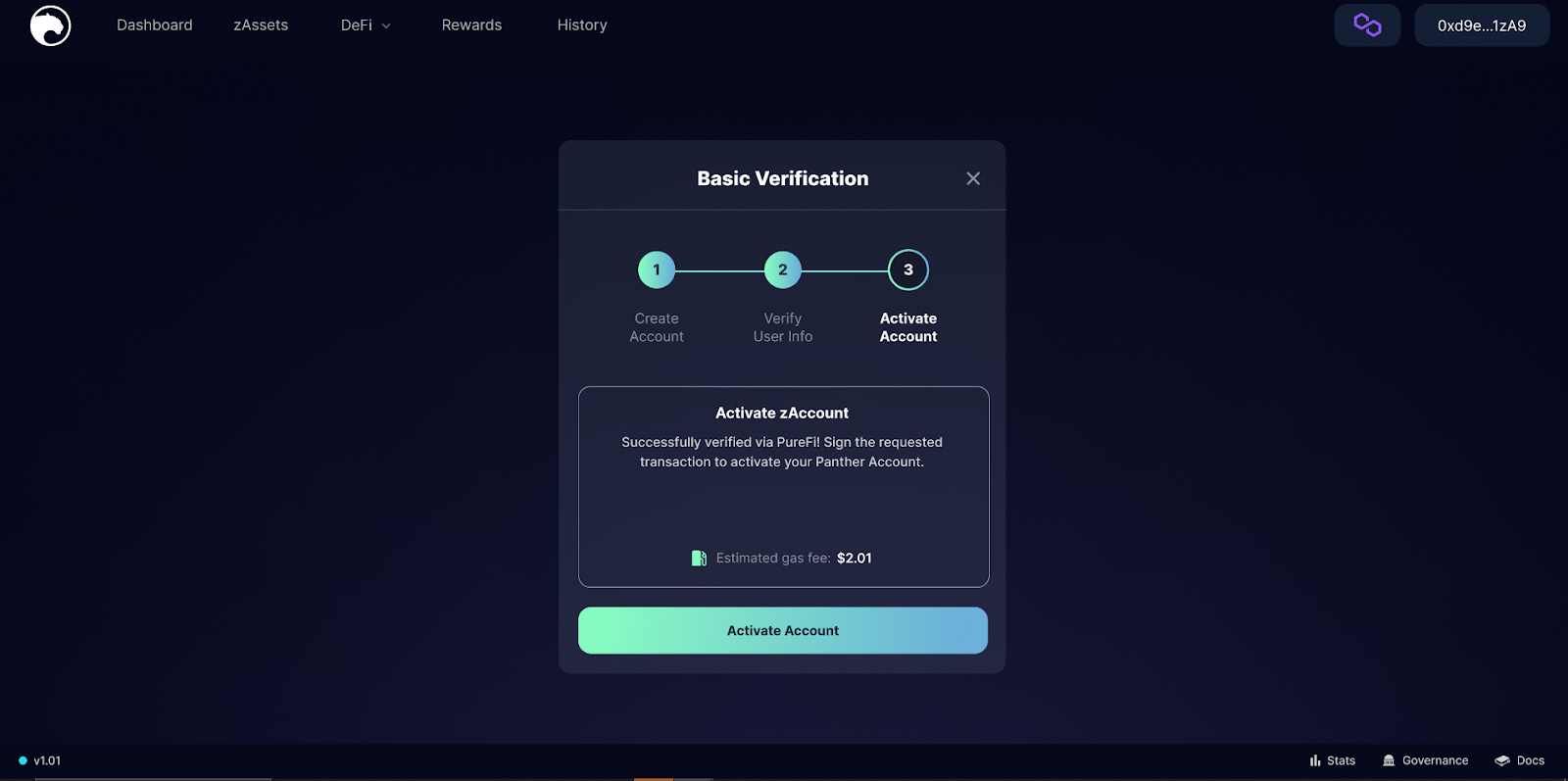
The zAccount is the end user's entrypoint to a Zone, and, thereby, to a [Shielded Pool](/docs/panther-core/panther-core/shielded-pool.md). A zAccount associates a user’s EOA (Externally Owned Account, i.e. a wallet) with their KYC attestation, as required by the [Zone Manager](/docs/ecosystem/ecosystem-operators/zone-manager.md).
The core functionality of the zAccount will be to delink the user’s transactions from their publicly-observable EOA. Additionally, it will let users prove their trades and balance in a privacy-enabled manner, and withdraw their assets back to a publicly owned wallet.
### zAccounts and privacy
When a user successfully passes KYC and activates their zAccount, the account Id will be made available from a public lookup table maintained by the Panther Smart Contract. This table will allow anyone to access the zAccount Id to find its two root public keys. These keys are required to spend and access [zAssets](/docs/panther-core/panther-core/overview.md). The critical outcome of the Protocol’s design is that EOAs/wallet address won’t be linked to trades within, or outwith the Protocol when using a [DeFi adaptor](/docs/interoperability/defi-adaptors.md).
### zAccounts and compliance
The Protocol is designed to allow the Zone Manager to define compliance, which is enforced as a compliance attestation required to validate a zAccount. This will enable Zone Managers to support decentralized identities and assign third-party KYC providers. Users can establish a Zero-Knowledge or zAccount following [successful verification](/docs/panther-core/compliance.md).
The Protocol can verify the completion and nature of the user’s verification without processing any personal data — while empowering the end user with tailored information sharing. It will employ advanced Zero-Knowledge methods to ensure the confidentiality and control of users’ transactional data on the blockchain.
To simplify compliance, each end user’s activities will be consolidated under a singular ledger, or zAccount.
### zAccount architecture
zAccounts are crafted using a specific type of unspent transaction output ([UTXO](/docs/learn/utxos/utxo-model.md)) within the Merkle Tree structure of UTXOs. Each zAccount UTXO will encapsulate critical user-specific details, including the zAccount’s unique identifier, asset balances, Zone ID, and more.
The Shielded Pool will assign every [zAsset](/docs/panther-core/panther-core/overview.md), represented by a [UTXO](/docs/learn/utxos/utxo-model.md) commitment, to an “owner” — the only zAccount able to spend it. This is achieved by including a *public (spending)* key in generating the UTXO commitment, for which only the zAsset recipient knows the corresponding *private (spending)* key.
However, rather than using a single fully-public spending key for each recipient, known to the whole world, a new spending keypair is derived. This pair is guaranteed to be unique for each UTXO — strengthening the system’s privacy while offering greater flexibility to disclosure schemes.
### What next?
* Deep dive into Panther Protocol’s [UTXO model](/docs/learn/utxos/utxo-model.md)
* Learn more about [Panther Protocol keys](/docs/learn/utxos/utxo-encryption.md#panther-protocol-keys)
---
# Agent Instructions
This documentation is published with GitBook. GitBook is the documentation platform designed so that both humans and AI agents can read, navigate, and reason over technical content effectively. Learn more at gitbook.com.
## Querying This Documentation
If you need additional information that is not directly available in this page, you can query the documentation by asking a question.
Perform an HTTP GET request on the following URL with the `ask` and `goal` query parameters:
```
GET https://docs.pantherprotocol.io/docs/panther-core/panther-core/zaccount.md?ask=&goal=
```
`ask` is the immediate question: it should be specific, self-contained, and written in natural language.
`goal` is what the user is ultimately trying to achieve, the reason they need the answer. Sharing it helps GitBook give you a better, more relevant answer. A goal is most helpful when it describes the outcome the user wants rather than restating the question. For example, with `ask=how do I create an API token`, a goal like `automate deployments from our CI pipeline` lets GitBook tailor the answer to that use case.
The response will contain a direct answer to the question and relevant excerpts and sources from the documentation.
Use this mechanism when the answer is not explicitly present in the current page, you need clarification or additional context, or you want to retrieve related documentation sections.